

TL;DR
Do you show up for others when it matters?
Give other people the chance to show up for you.
I’m grateful for people showing up for me and a short reading from my book, The Tech Drama.
This past weekend I went to a funeral for a friend’s grandmother. As I walked through the church doors my friend saw me and her eyes widened, “Thank you so much for coming,” she said. As I stood in the church pews, I reflected on the momentary recognition of gratitude and what it means to show up.
Last month I did something I have never done. I threw a party for myself.
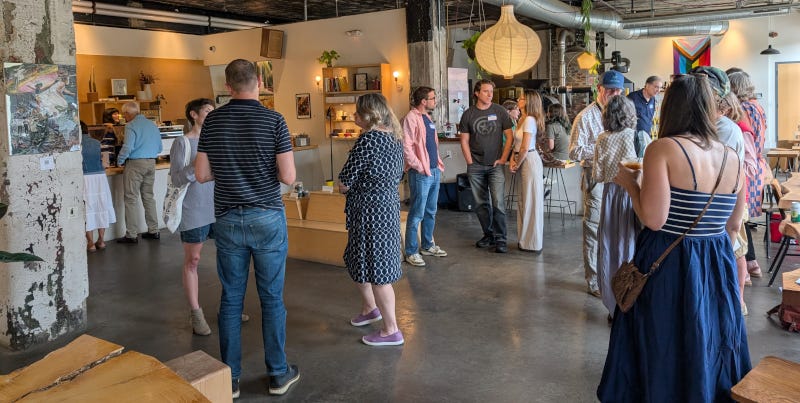
I am one of the last people who would ever self-promote.
Why would anyone want to celebrate me or my accomplishment?
Over the last ten years, since the inspiring incident for my book, The Tech Drama, I’ve come to the conclusion my resistance to celebrating my accomplishment is much more about me than other people. The Tech Drama is also about deep change.
The book’s narrator, who shares my name, would have also struggled to celebrate himself. However, I have realized I am the sort of person who shows up for people. Throwing a party for my accomplishment gave people a chance to show up for me. --And they did.
Before I had even announced a date for the party I worried that I was going to invite 100 people and no one would show up. In the end, a few people who RSVP’d forgot. However, this was balanced out by the people who didn’t RSVP and showed up as well as the people who RSVP’d and brought a +1.
I worried about the invitations, venue, and the refreshments, but I made a list and worked it. It worked out.
The party lasted about 90 minutes. An hour in, I turned on the public address system I had rented and quietly spoke up.
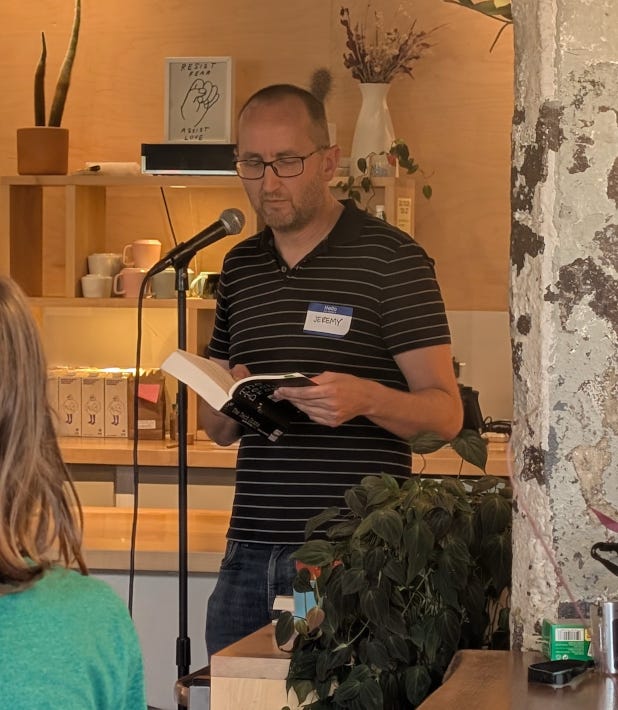
“Thank you all for coming.” I looked out at the crowd.
My kids. My girlfriend. My parents.
     A college professor.
          My former teammates, now friends.
               My former colleagues, now friends.
                    Friends from school.
                         Friends from who knows where? And who cares?
                    An ex brother in law.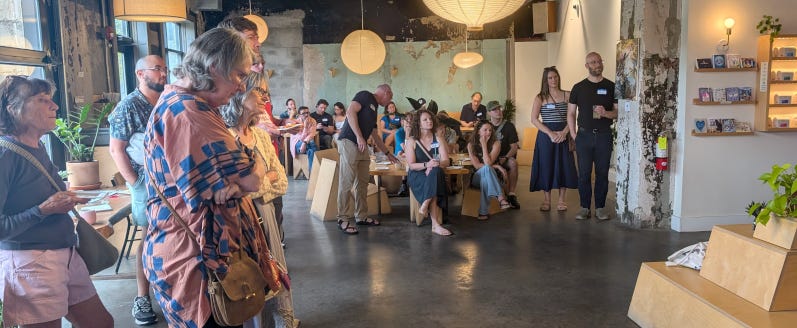
I spoke from the heart, though I had an idea of what I would say.
“As I prepared for this moment, thinking about the reading I planned to do, I was afraid. Now that the moment is here, looking out at each of you, I don’t feel the fear at all. I see people who I care for and who care for me. There’s not one of you who I would have to hold anything back for, which means so much.”
“The subtitle of my book is, ‘Focus, Work the Problem. You are not crazy. Maybe.’ The idea of craziness, feeling insane--I think it’s not so far from the truth these days, whether it’s politics, social media, or in the case of my book, work. I want to start off by reading a passage from a book I was supposed to read in high school. I say supposed to because I think back then I just read what I thought I had to, to pass the test. Two years ago, I was walking, listening to Beloved, by Toni Morrison, and I came across this passage, which just struck me as truth. I think it gets to the heart of how we unwind that feeling of craziness.”
As I spoke, I picked up a paperback of Beloved. I opened to a page marked by a yellow adhesive tab.
I began setting the stage, “One of the main characters is being tormented by a ghost and it the whole situation is becoming the subject of local gossip. While the town is talking, the main character is suffering intensely.” I scanned to the last paragraph of the page and began to read.
It took them days to get the story properly blown up and themselves agitated and then to calm down and assess the situation. They fell into three groups: those that believed the worst; those that believed none of it; and those, like Ella, who thought it through.[1]
I closed the book and looked up. I spoke from the heart again, “The context is different, but there’s no getting around the incredibility of the situation. The truth of the people who believe the worst and the people who believe nothing speaks directly to the polarization we see everywhere. When I think about everything that I am, I write for the last group, the Ella’s of the world; the ones who think it through and then act in the service of others.”
I picked up the bigger, black paperback, my book. I opened to a pink, adhesive tab.
I spoke, “Now, I’ll read from my book, The Tech Drama. In this scene, the narrator’s company has just been through a bankruptcy, a long-time colleague has just been fired, and things are feeling shaky. In the process, the narrator has just gotten word he has a new boss.” I began to read..
Andy accepted the role.
I had been advocating a leadership meeting between heads of the groups within radiology since I had found out we were going to be reorganized. Before the restructuring, each of us, product management, engineering, support, implementations, and sales were equals. No one had power over another. I thought we needed to better understand one another’s concerns.
Andy setup a leadership call two days later.
A good sign.
Andy began, “I’m really sorry we can’t all be there in Pittstown, but I’ve known all of you for forever. It’s really all about relationships, Jeremy.”
Did he just say my name?
Andy continued, “Phil, how long have we known each other?”
“It’s been a long time, Andy,” Phil replied.
“You see, Jeremy, it’s about relationships.”
Did I just hear… what?
“PJ, great to talk to you again. Our relationship is really strong, Jeremy.“
“Thanks, Andy, it’s good to be working together again,” PJ responded.
“—Yes, it is. Oh, sorry for talking over you.”
Andy hadn’t talked over him. I thought, ‘This is getting weird.’
“Barbara, we’ve been working together a long time. This really would be much more difficult for me if we didn’t have that relationship established. Sorry, we aren’t all there in Pittstown, Jeremy.”
Barbara shared a quick, “Thanks, Andy.”
Andy continued, “Mick, thanks for doing so much in the last few days. We’ve known each other forever, and sales has been in such great hands, Jeremy.”
Mick responded, “Thanks, Andy. I feel really good, like we’re turning a corner.”
“That’s great, Mick. I sure hope—sorry for talking over you.” Andy paused. “I sure hope so.”
I told myself,
Head down. Do your best. There’s something going on here, and you’re going to have to work through it.
“I want to have a regular leadership meeting with all of you. You see, Jeremy, I really want to have a good relationship with each of you.”
I was surprised the first time he spoke my name. By the fifth, speechless.
I spun,
What’s this about relationship?
What’s with all the Jeremy’s?
Did I talk over Catherine?
Maybe.
What’s with all the Jeremy’s?
Did I talk over Catherine?
Oh, god, I think I did.
What’s this about relationships?
Catherine said Andy was an idiot,
many times, but Andy says they are bonded.It was the weirdest meeting I had ever been in, up to that point.
After the meeting, I went to get coffee at the shop down the street. It was a nice way to unwind and get away.
I walked by Pete, the IT guy, in the hallway on the way back to my desk. IT Pete had been talking with Ilya and Karyn when Karyn had pulled me aside that first week.
In a curt tone of disinterest he asked me, “Are you happy, Jeremy?” There was no pause for a response. I turned to him, but he was gone...
I closed the book, and looked up. I continued right away, fearful of applause or ... lack of applause. “Andy was right. It is about relationships. Yet I think Andy is only half right. Over the next 100 pages, Andy, IT Pete, and others go on to gaslight the narrator. These people relate to each other, in service of their perception of an unjustly fired coworker. --But their loyalty is misplaced. Instead of seeking truth, they accept a narrative and use it to justify exerting fear and control over the narrator. I think this is one model of relationship: relationships that are about control. In such a relationship, a dominant person is the source of truth. Loyalty is the blind acceptance of the truth provided by the dominator. That’s not what I see when I look around at all of you.”
I paused for a moment, eyes scanning the audience. Then I continued, “I remember having a conversation with a man who is here tonight. We came to the joint insight that the only true loyalty is loyalty to the truth. This is not the truth of the dominant person, this is the truth of the honest account of your own perspective as well as listening to and incorporating the honest perspectives of those around you. It’s seeking out the unheard perspective. It’s reserving judgment. I think this is a particularly important thing to keep in mind today. It’s for those who think it through.”
I paused for a moment.
“Before I conclude, I want to lean into the word truth. I love the ‘T’ ‘R’ ‘U’ words. Truth. True. And trust. Trust is what I feel here, with all of you. Again, it’s so easy to speak to all of you, because I trust you. In another time I might not have.”
“I had a conversation a few days ago with someone who had read the book. He commented on the unreliable narrator. The narrator doesn’t believe in himself, he questions his own reliability. This is by design, but I think by the end of the book we find the narrator was actually the most reliable source. The narrator needed to go through the journey to trust himself.”
“The book is an autofiction, which is short for autobiographical fiction. As I close I recognize there are characters in the narrator’s journey that believe in and support him. They couldn’t do the work for him, but they were necessary. In this moment, a book launch in a coffee shop, I come to the gratitude I feel for all of you. I couldn’t have written this book without the demonstration of your trust and your support. I love you all. Thank you.”
Then came the gentle applause I feared would come and feared would not come.
There had never been anything to fear.
Morrison, Toni. Beloved. Knopf, 1987.↩︎